jonathanjuliani
Implementing Queues with NodeJS and Javascript
FIFO queues in JavaScript/Node.js: simple implementation, priority patterns, and where queues show up in production apps.

Job queues, message buffers, fair processing — FIFO: first in, first out. push + shift works until the queue gets huge.
What you'll learn:
enqueue/dequeuewith an array- Why
shift()can hurt at scale - When a linked list helps
- BFS (ep. 14) as a queue in the wild
Prerequisites: stacks (ep. 4) and linked lists (ep. 3).
Queue (FIFO): arrays in practice
Dealing with Sequential Data
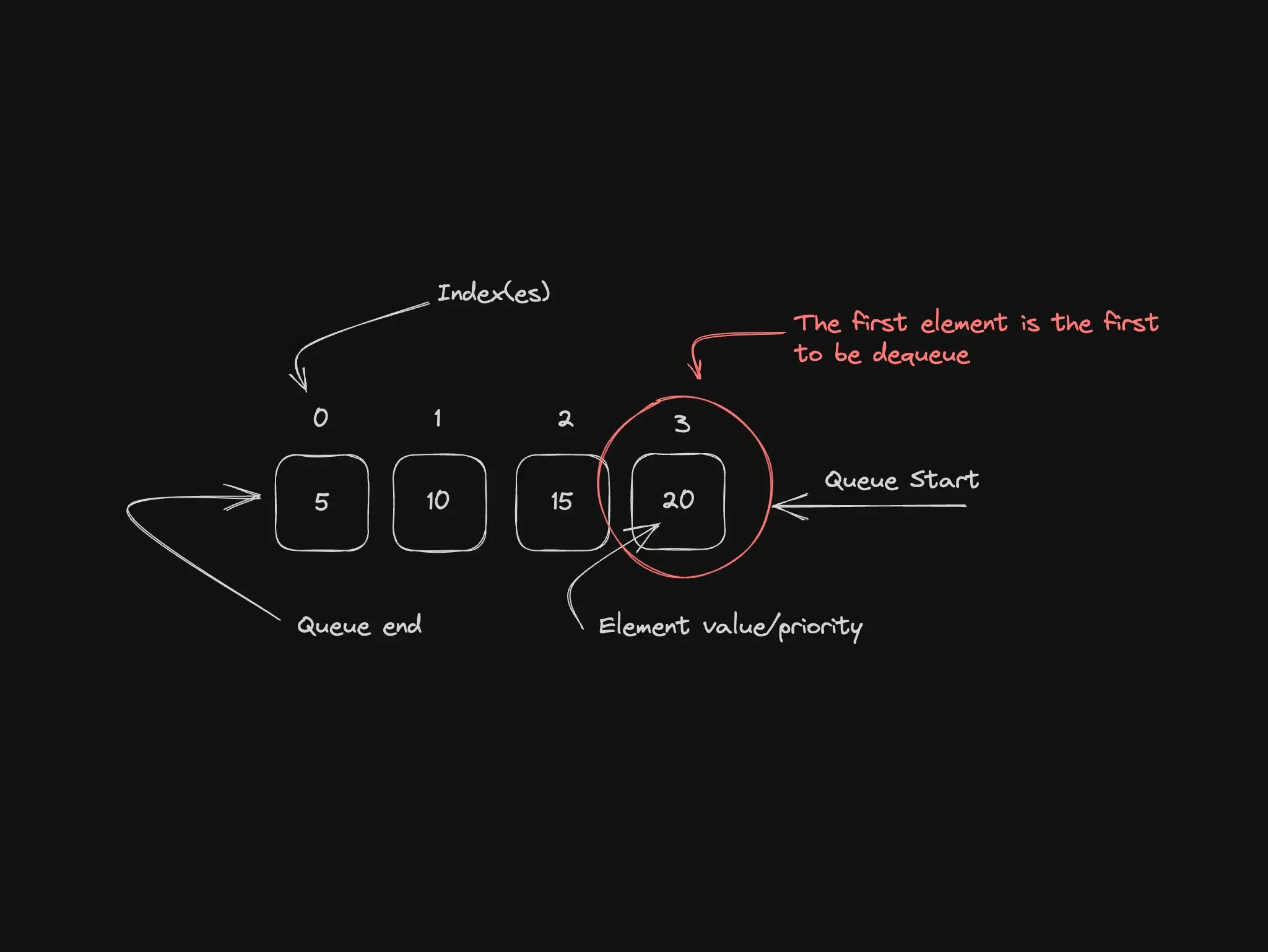
Queues are one of the main data structures and one of the most used by a lot of softwares to deal with sequential processes and stuff like that. Queues follow the FIFO principle, which means, first in, first out. In other words the first element to get to the queue will be the first to be removed or processed.

Implementation
Queues like I said above have to be an structure that adds new elements as the last element and removes/processes starting from the first position (index).
Just like Stacks, queues can be implemented using arrays with NodeJS/Javascript. A basic implementation should have functions (or methods) such as: enqueue, dequeue, peak or get to check the first element and so on...e.g:
class Queue {
constructor() {
this.items = []
}
// Adds an element to the queue
enqueue(element) {
this.items.push(element)
}
// Removes the first element of the queue
dequeue() {
if (this.isEmpty()) return 'Underflow' // queue is empty
return this.items.shift()
}
// Get the first element of the queue (without removing it)
front() {
if (this.isEmpty()) return 'No elements in Queue'
return this.items[0]
}
// Check if the queue is empty
isEmpty() {
return this.items.length === 0
}
// Logs the queue
printQueue() {
let str = ''
for (let i = 0; i < this.items.length; i++) str += this.items[i] + ' '
console.log(str)
}
}Edge cases: shift() is O(n)
Each dequeue with shift() moves every element. At millions of items, use a head index, a linked list, or a library queue.
Why not pop(0)? Also O(n). FIFO at index 0 is the painful part of array-based queues.
TL;DR — Queue
| Approach | dequeue | Note |
|---|---|---|
| push + shift | O(n) | Fine for small queues |
| head index | O(1) | Same array, no shift |
| linked list | O(1) | head/tail pointers |
Next steps
Before you go
Where have you used a real queue — Bull, SQS, or a home-grown array? Comment the gotcha that bit you.
Subscribe to the Engineering Ledger
Get architecture and performance notes in your inbox. Same list as the timed prompt—subscribe here anytime.
Related articles

Data Structures and Algorithms - A Summary of The Most Used Ones
Practical overview of the data structures and algorithms you use most in JavaScript/Node.js — with examples and links to go deeper.
Read story
Implementing Arrays with NodeJS and Javascript
JavaScript arrays in Node.js: essential methods, immutability patterns, and when an array beats other structures. Hands-on guide.
Read story