jonathanjuliani
Meeting Graph Algorithms with NodeJS and Javascript
BFS and DFS on graphs in JavaScript: visit order, queue vs stack, and visual examples. Data structures in a Nutshell episode.

A graph from ep. 7 is inert without traversal. This episode implements BFS and DFS — foundation for shortest paths (unweighted), cycles, and topological order.
What you'll learn:
- BFS with a queue and visited set
- DFS recursive and iterative
- when BFS finds shortest path (no edge weights)
- cycle detection with DFS
Prerequisites: graphs (ep. 7).
BFS and DFS: traverse without infinite loops
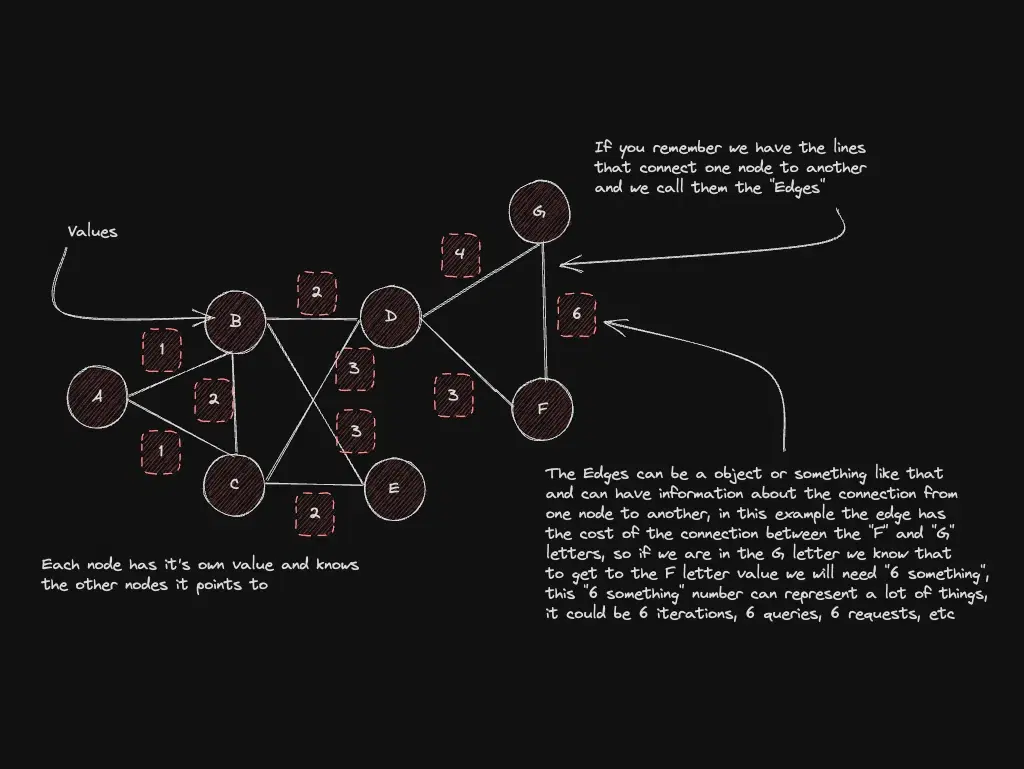
Back in Part 7 we built a Graph structure with nodes and edges. Having the data structure is great, but without algorithms to navigate it, we're just storing a map without being able to use it. That's what this post is about: Breadth-First Search (BFS) and Depth-First Search (DFS)—the two fundamental algorithms for exploring a graph.
To keep things concrete, we'll use this graph for all our examples:
scene: en/data-structures-in-a-nutshell/graph-sample
Interactive Excalidraw view is not available in this build.
graph LR A --- B A --- C B --- D B --- E C --- F C --- G
Starting from node A, BFS and DFS will each visit all nodes—but in a completely different order.
Hands-on
First The Theory
BFS — Breadth-First Search
BFS uses a queue. It visits all neighbours of the current node before moving deeper. Think of it as expanding a wave: first every node one hop away, then every node two hops away, and so on.
scene: en/data-structures-in-a-nutshell/graph-bfs-order
Interactive Excalidraw view is not available in this build.
graph LR A["A (1st)"] --- B["B (2nd)"] A --- C["C (3rd)"] B --- D["D (4th)"] B --- E["E (5th)"] C --- F["F (6th)"] C --- G["G (7th)"]
BFS visit order from A: A → B → C → D → E → F → G
DFS — Depth-First Search
DFS uses a stack (or recursion). It dives as deep as possible along one path before backtracking. Think of it as exploring a maze: go all the way down one corridor, then come back and try the next one.
scene: en/data-structures-in-a-nutshell/graph-dfs-order
Interactive Excalidraw view is not available in this build.
graph LR A["A (1st)"] --- B["B (2nd)"] A --- C["C (5th)"] B --- D["D (3rd)"] B --- E["E (4th)"] C --- F["F (6th)"] C --- G["G (7th)"]
DFS visit order from A (following insertion order): A → B → D → E → C → F → G
Now The Practice
We'll reuse the Graph from Part 7. Paste the full file to start:
class Graph {
constructor() {
this.numberOfNodes = 0
this.adjacentList = {}
}
add(node) {
this.adjacentList[node] = []
this.numberOfNodes++
}
addEdge(node1, node2) {
this.adjacentList[node1].push(node2)
this.adjacentList[node2].push(node1)
}
}Now let's add the BFS method to the Graph class:
bfs(start) {
const visited = new Set()
const queue = [start]
const order = []
visited.add(start)
while (queue.length) {
const node = queue.shift()
order.push(node)
for (const neighbour of this.adjacentList[node]) {
if (!visited.has(neighbour)) {
visited.add(neighbour)
queue.push(neighbour)
}
}
}
return order
}Breaking it down:
- We start with a
Setto track visited nodes (so we don't loop forever in cyclic graphs) and aqueueseeded with the start node. - On each iteration we pull the front of the queue (
shift()), record it, and enqueue all its unvisited neighbours. - Because we process the queue front-to-back, we naturally visit nodes level by level.
Now let's add DFS:
dfs(start) {
const visited = new Set()
const order = []
const explore = (node) => {
visited.add(node)
order.push(node)
for (const neighbour of this.adjacentList[node]) {
if (!visited.has(neighbour)) {
explore(neighbour)
}
}
}
explore(start)
return order
}Breaking it down:
- We use a recursive helper
explorethat marks a node visited, records it, then immediately recurses into each unvisited neighbour. - Because we go deep into the first neighbour before considering siblings, we get the depth-first order.
Let's test both. After the class, add:
const g = new Graph()
g.add('A')
g.add('B')
g.add('C')
g.add('D')
g.add('E')
g.add('F')
g.add('G')
g.addEdge('A', 'B')
g.addEdge('A', 'C')
g.addEdge('B', 'D')
g.addEdge('B', 'E')
g.addEdge('C', 'F')
g.addEdge('C', 'G')
console.log('BFS from A:', g.bfs('A'))
console.log('DFS from A:', g.dfs('A'))Run it:
node graph-algorithms.jsExpected output:
BFS from A: [ 'A', 'B', 'C', 'D', 'E', 'F', 'G' ]
DFS from A: [ 'A', 'B', 'D', 'E', 'C', 'F', 'G' ]AWESOME!
Both algorithms visited all 7 nodes, but in completely different orders. BFS went wide (all direct neighbours of A first), while DFS went deep (followed the B branch all the way down before touching C).
Can I do iterative DFS instead of recursive?
Absolutely! Replace the explore function with a stack:
dfsIterative(start) {
const visited = new Set()
const stack = [start]
const order = []
while (stack.length) {
const node = stack.pop()
if (visited.has(node)) continue
visited.add(node)
order.push(node)
for (const neighbour of this.adjacentList[node]) {
if (!visited.has(neighbour)) stack.push(neighbour)
}
}
return order
}The iterative version uses an explicit stack instead of the call stack—safer for very large or deep graphs where recursion could hit the stack limit.
Edge cases: visited set, shift, stack depth
Without a visited Set, any cycle loops forever. Mark nodes when you enqueue/push, not only when you process.
Deep recursive DFS can exceed Node's stack — use an explicit stack for large graphs.
BFS on weighted graphs does not guarantee cheapest path — use Dijkstra with a priority queue.
TL;DR — BFS vs DFS
| structure | typical use | |
|---|---|---|
| BFS | queue | shortest steps, levels |
| DFS | stack | cycles, topo sort |
Next steps
Before you go
BFS or DFS in production? Comment if the sample graph has a bug.
Subscribe to the Engineering Ledger
Get architecture and performance notes in your inbox. Same list as the timed prompt—subscribe here anytime.
Related articles

Data Structures and Algorithms - A Summary of The Most Used Ones
Practical overview of the data structures and algorithms you use most in JavaScript/Node.js — with examples and links to go deeper.
Read story
Implementing Arrays with NodeJS and Javascript
JavaScript arrays in Node.js: essential methods, immutability patterns, and when an array beats other structures. Hands-on guide.
Read story